Guest post from my Wife:
Henry Wadsworth Longfellow, writing in the mid-nineteenth century, seems to have an understanding of the relationship between man and wife, that is severely lacking in our day, despite, or maybe because of, all our obsession with making things “equal between the sexes”.
He begins Chapter 10 of his Epic Poem, Hiawatha, by saying:
"As unto the bow the cord is,
So unto the man is woman;
Though she bends him, she obeys him,
Though she draws him, yet she follows;
Useless each without the other!"
At the end of the chapter, he again sums up the interplay of interdependence of man and woman in the advice given to Hiawatha and Minnehaha, Laughing Water, by the sun and the moon:
From the sky the sun benignant
Looked upon them through the branches,
Saying to them, "O my children,
Love is sunshine, hate is shadow,
Life is checkered shade and sunshine,
Rule by love, O Hiawatha!"
From the sky the moon looked at them,
Filled the lodge with mystic splendors,
Whispered to them, "O my children,
Day is restless, night is quiet,
Man imperious, woman feeble;
Half is mine, although I follow;
Rule by patience, Laughing Water!"
Though we moderns might wince at the word, “feeble”, yet look who is ruling: both, “Rule by love, O Hiawatha . . . Rule by patience, Laughing Water!” A beautiful echo of the words of St. Paul in Ephesians:
“Submit to one another out of reverence for Christ. Husbands, love your wives, just as Christ loved the church and gave himself up for her. However, each one of you also must love his wife as he loves himself, and the wife must respect her husband.”
Anthropologist Margaret Mead said, “Every adjustment that minimizes a difference, a vulnerability, in one sex, a differential strength in the other, diminishes the possibility of complementing each other, and leads to a duller vision of human life in which is denied the fullness of humanity that each might have had.” (quoted from Preserve Them, O Lord)
St. Gregory the Theologian said, “In our living together, we are one another’s hands, ears, and feet. Marriage redoubles our strength, rejoices our friends, causes grief to our enemies. A common concern makes trials bearable.”
Oh, that we moderns, with all our “wisdom,” might regain but a small measure of the wisdom of the ancients.
Monday, April 9, 2012

Thursday, April 5, 2012
Michael Faraday the great experimentor

An excellent lecturer, Faraday gave a series of talks for boys and girls that became the wonderful book: The Chemical History of a Candle. In the lectures, Faraday uses a candle as a bridge to discuss chemicals and their reactions, gasses, the atmosphere, gravity, and so much more. He said "there is not a law under which any part of this universe is governed which does not come into play and is touched upon in these phenomena. There is no better, there is no more natural philosophy than by considering the physical phenomena of a candle."
The lectures demonstrate his great skills at experimentation and scientific reasoning that are very easy to grasp. A true model of the scientific endeavor and a worthy classic to be studied by students of science.
Wednesday, April 4, 2012
Of Stories and Essays
”Bree said, ’And now, Tarkheena, tell us your story. And don’t hurry it – I’m feeling comfortable now.’
”Aravis immediately began, sitting quite still and using a rather different tone and style from her usual one. For in Calormen, story-telling (whether the stories are true or made up) is a thing you’re taught, just as English boys and girls are taught essay writing. The difference is that people want to hear the stories, whereas I never heard of anyone who wanted to read the essays.”
– C.S. Lewis, The Horse and His Boy
Monday, April 2, 2012
The True Order of Knowledge
"It is better to be a simpleton and to approach God with love than to be a know-it-all and, at the same time, be an enemy of God." These are the words of the priest-martyr, St. Iraneaus of Lyon. The truth of these words have been confirmed at all times and is also confirmed in our time. One thing must be added to this, namely, that the lovers of God are not simpletons because they know God well enough that they are able to love Him. Of all human knowledge, this knowledge is more important and greater. To this must be added that the enemies of God cannot be more knowledgeable, even though they consider themselves as such, because their knowledge is unavoidably chaotic, for it does not have a source and does not have order. For the source and order of all knowledge is God. Some of the saints, such as Paul the Simple, did not know how to read or write yet with the strength of their spirit and divine love surpassed the entire world. Whosoever approaches God with love, that person is not capable of crime. Knowledge without love toward God is motivated by the spirit of criminality and war. St. Euthymius the Great taught: "Have love; for what salt is to food, love is to every virtue." Every virtue is tasteless and cold if it is not seasoned and warmed by divine love.
(source: The Prologue from Ohrid, April 2)
Friday, March 30, 2012
A Sinful Monk Who Died Joyfully
This monk was lazy, careless, and lacking in his prayer life; but throughout all of his life, he did not judge anyone. While dying, he was happy. When the brethren asked him how is it that with so many sins, you die happy? He replied, "I now see angels who are showing me a letter with my numerous sins. I said to them, Our Lord said: `stop judging and you will not be judged' (St. Luke 6:37). I have never judged anyone, and I hope in the mercy of God that He will not judge me." And the angels tore up the paper. Upon hearing this, the monks were astonished and learned from it. (from the Prologue of Ochrid)
Sunday, March 25, 2012
Greek and Latin in the 18th Century
From Letter XLIX of Lord Chesterfield's Juvenile letters:
"Pray mind your Greek particularly; for to know Greek very well is to be really learned : there is no great credit in knowing Latin, for everybody knows it; and it is only a shame not to know it."
"Pray mind your Greek particularly; for to know Greek very well is to be really learned : there is no great credit in knowing Latin, for everybody knows it; and it is only a shame not to know it."
Thursday, March 22, 2012
A Classical Education through Email?
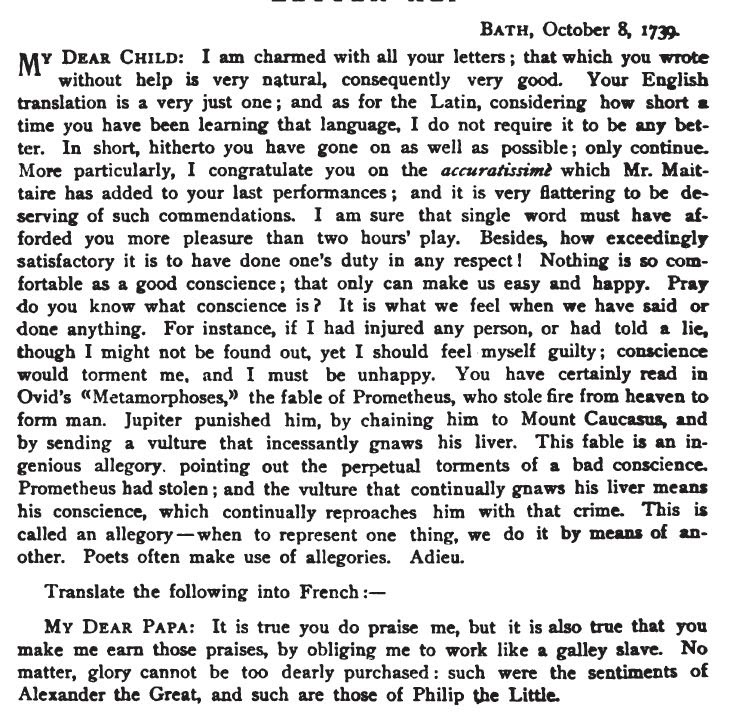
The letters can be found in the back of volume II of Lord Chesterfield's Letters to His Son (page 341ff) . I downloaded a free pdf of the book and then took snapshots of the individual letters and sent them to my son through email. It's kind of like getting a letter from the 18th century. I've included a couple of examples at the beginning and end of this post (click on them to make them more readable). It's a painless and fun way to approach some basic classical knowledge.

Subscribe to:
Posts (Atom)