Quotes

“Education is an atmosphere, a discipline, and a life.” – Charlotte Mason

"To educate man is the art of arts, for he is the most complex and mysterious of all creatures." - Gregory the Theologian

Thursday, March 22, 2012

A Classical Education through Email?

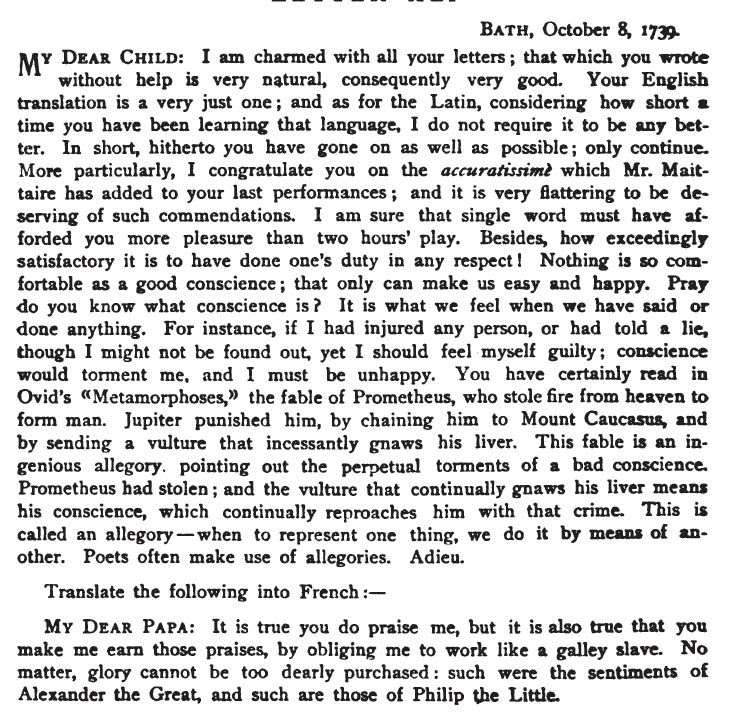
About a year ago I began to email my son the juvenilia of Lord Chesterfield (a letter per week).  Lord Chesterfield wrote hundreds of letters to his son in the middle of the 18th century.  His early letters were an attempt to give his son a classical education while they were apart.  Chesterfield's juvenilia includes basic instruction in history, myth, geography, chronology, poetry, oratory, and virtue.  It reminds me of Famous Men of Rome or Fifty Famous Stories Retold, but with a personal touch.  Most are appropriate for children around the age of ten (I have only had to censor one letter in the first forty seven)        


The letters can be found in the back of volume II of Lord Chesterfield's Letters to His Son (page 341ff)  . I downloaded a free pdf of the book and then took snapshots of the individual letters and sent them to my son through email.  It's kind of like getting a letter from the 18th century.  I've included a couple of examples at the beginning and end of this post (click on them to make them more readable).  It's a painless and fun way to approach some basic classical knowledge.


Monday, March 19, 2012

A Princess of Mars - 1917 versus 2012

Original Artwork - 1917

 Dejah Thoris - 2012
My 11 year old son enjoyed reading the Edgar Rice Burroughs' Martian Tales, so I took him to see the new movie of the first book in the series, John Carter of Mars.  We both enjoyed the movie and weren't too put off by the plot changes made in order to make it to the big screen.  More interesting to me than the plot changes, however, was the way that the characters were changed to make them suitable to a modern audience. 

John Carter, the protagonist of the books, is portrayed in the movie as an adventurous, though none-too-bright, disgruntled and angry civil war veteran, who is mostly out for himself until he falls for the Princess of Mars.  In the book he is a southern gentleman, who though a man of war, is filled with virtue and compassion, he even teaches the green men of Mars to treat their beasts of burden with kindness.

The contrast between the 1917 princess and the 2012 version is even more striking and is captured in the two poses found in the images above.  The modern princess is a warrior in her own right in contrast to the Dejah from 1917.  The following quote from the book also illustrates how "far" she has come:  "I am happy here. I do not know why it is that I should always be happy and contented when you, John Carter, a stranger, are with me; yet at such times it seems that I am safe and that, with you, I shall soon return to my father's court and feel his strong arms about me and my mother's tears and kisses on my cheek."  Alas, not the stuff of the modern princess.

Sunday, March 11, 2012

An 11 year old boy's favorites

One year ago I asked my 10 year old son to give me a list of his favorite books, and it proved to be a quite popular post.  So, I asked him to give me another list this year and here it is:

  1. The Hobbit
  2. Here There Be Dragons (series)
  3. Harry Potter (series)
  4. 100 Cupboards (series)
  5. The Precious Pearl
  6. The Boy's King Arthur
  7. Swallows and Amazons (series)
  8. Redwall (series)
  9. Martian Tales Trilogy

Thursday, February 23, 2012

Lines from The Princess Bride that Double as Comments on Freshman Composition Papers


“You keep using that word. I do not think it means what you think it means.”
“At a time like this that’s all you can think to say?”
“Nonsense. You’re only saying that because no one ever has.”
“I don’t think I’m quite familiar with that phrase.”
“I would not say such things if I were you!”
“I do not suppose you could speed things up?”
“Skip to the end!”
“That is the sound of ultimate suffering.”
“Inconceivable!”

Friday, February 3, 2012

The Word of a Gentleman and the Way of a Lady

Several years ago Evan Wilson put together some talks to college men to teach them how to be gentlemen.  They were so popular that the ladies demanded their own talks and these were added.  With both style and humor, Wilson has given us 15 "rules" for gentlemen and 15 "rules" for the ladies.  I ordered my book from him a couple of years ago and have enjoyed it immensely.  I plan to discuss these at the dinner table as my children get older.  Now I see that it is available on Amazon, so I thought I'd pass on a link to this helpful resource.

Thursday, January 19, 2012

Dr. Johnson's Best

Early in James Boswell's The Life of Samuel Johnson, he mentions that Dr. Johnson was once overheard saying that the best thing he ever wrote was The Vision of Theodore, the Hermit, found in his Cell.  It was only a google away, so I sat down and read this marvelous allegory about the Path to Happiness on the Mountain of Existence.  Go read it, it could easily work as an Ambleside Online Selection.  

Friday, January 13, 2012

Memory and the Church Fathers


While reading the Conferences of John Cassian I began to marvel at the encyclopedic scriptural memory of the desert monastics that were interviewed by Cassian and his friend Germanus.  How did they do it?  Not only did they remember large portions of scripture, but their memory functioned like a topical bible or concordance that could pull references from all parts of scripture.  I had to know.

The Book of Memory: A Study of Medieval Culture by Mary Carruthers offered the answers.  Carruthers extensive research explains the place and use of memory in medieval culture and most interestingly explores the different arts and techniques that were employed.  For instance, many Christians would memorize the entire Psalter, which  usually took two to three years.  Hugh of St. Victor wrote a short treatise to explain his personal method, which included the following steps:
  1. Visualizing a grid with 150 locations, one for each Psalm.
  2. Behind each number the first few words of each Psalm would be memorized, so that one had the complete reference system for all 150 psalms.
  3. Then the individual Psalms themselves would be memorized.
Other techniques for memorizing lists or the contents of the gospels would use visualization and mental pictures to help with the recollection and organizing of data.  The goal of this memorization wasn't simply to know a lot of information, but to be an aid in contemplation and invention.

I wanted to use some of these methods with my children and discovered a book that uses some of these medieval techniques for a modern audience:  Memorize the Faith (And Anything Else) by Kevin Vost.  We started memorizing the Beatitudes from the Sermon on the Mount last week and we have had great success.  It took us about 15 minutes to memorize them and we can now recall them forward or backward or starting at any point.  I highly recommend this book!